Why are you still writing JIRA tickets?
The time of the typical ticket-writing product manager is long gone; we could even argue that the role was never meant to be this way. But let's not go down that path.
The role has always been meant to be at the intersection of strategy, customer empathy, and technical execution.
Product managers didn't have to be technical visionaries to succeed, but the best ones often still possess some technical depth.
The main skill is understanding the customer deeply and translating their needs into business goals and specifications. This allows engineers and designers to understand the vision and help build the right solutions.
Everyone seems happy, right?
Wrong.
More often than not, features were added to products because "stakeholders" required it, because it was just cool to do, or one of my favorites, "because the engineering team would otherwise run out of work."
The result?
Products that are unnecessary, complex and confusing to users; if any showed up in the first place. There are still many products that get built without anyone ever using them. In software engineering, writing code has never been the bottleneck. Being a feature factory is choosing the path of least resistance.
In the age of generative AI, the role of the product manager is getting even blurrier, especially when the PM role in a larger organization is one of a glorified ticket writer. Because administrative tasks are something that large language models can do quite well. Writing a product backlog item or a simple spec is easy. It's no wonder we hear on social media that the job of the product manager is dead.
While I don't think the job is dead, it's changing for sure. The most valuable skill for a product manager is still discernment, knowing what needs to be built and why. Figuring that out still takes most of the time.
Customers, Customers, Customers
With AI coding tools at their disposal, I believe product managers now need to make a more technical shift. They need to be able to write code, even if it's vibe coding in the beginning.
Because ultimately this could decrease the risk of long engineering cycles by creating and testing prototypes themselves. If they are in smaller organizations, they will be mainly responsible for prototyping, while in larger organizations they might get help from product designers.
PMs can now go full cycle, from validation to execution. Building and launching interactive prototypes in days, getting customer feedback quickly before investing engineering resources.
As AI leaders like Andrew Ng have pointed out, the ability to rapidly prototype with AI coding assistants is becoming a baseline skill.
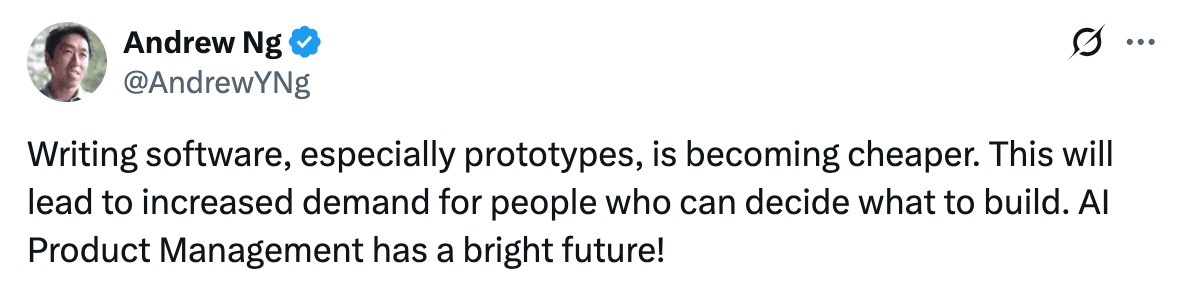
Andrew also argues that we will see software engineers move more towards product management roles, because they can free up time from their engineering work thanks to AI coding tools.
As the roles of product manager and engineer converge, it's crucial for non-technical PMs to become familiar with code, or they risk seeing their overall value disappear. Building prototypes will help you a lot with discernment and product sense.
Enjoyed this? Subscribe for new essays.
Knowing what they want
The bottleneck will always be that your customers and prospects have a limited bandwidth; we're only humans after all. So they can only test and select a few products. It's your task to make sure that it's your product they want.
If you're not talking with your customers, you won't figure out where potential opportunities lie.
With the ability to prototype, is the Product Requirements Document (PRD) now obsolete?
I think there is still value in having a PRD, to align everyone on the same page. To document all the findings, the opportunities and the solution that you are going to go after as a company and as a team.
Especially if you are working on something for a while, it's important to revisit the PRD and make constant adjustments. It's the constant aligning factor.
Even more so in the era of AI, where new models that are released could impact your ideas and capabilities of your product.
One thing is clear, the era of the PM as the product builder has begun.
Get the next bite sized AI insight inside your inbox.
